












A thing of beauty is a joy forever, or so John Keats (1795–1821) stated in the opening stanza of his poem Endymion (1818). While the line is well-known, its”meaning in relation to the story of the shepherd Endymion and his complicated love life is rather more obscure. In fact, when you consider exactly what is meant by that opening line, you must wonder if anything should be a joy forever.
Before I get to Keats, I should mention that during the 19th century, the name Endymion was famous because of the book of the same name by Benjamin Disraeli, Earl of Beaconsfield, a former prime minister and best-selling novelist, beloved by the public for his romanticism, which often came with a political edge. When he published his final novel Endymion in 1880, the newspapers wrote that “first class passengers, especially ladies, carry it with them as they would a favorite pug or a flask of fluid refreshment.” In Disraeli’s novel, Endymion is the son of a disgraced politician, determined to redeem the family name by becoming a politician for the other side. Disraeli’s hero is good, virtuous, and ultimately successful, with the book ending on his assent to prime minister. The connection to the poem is purely superficial, but the name is used to denote goodness and love together with a sense of renewal and revitalization. You could also guess that for the young women clasping the book as they traveled, it was a joy until the last page, if not forever.
The wellspring of the name, well known to Disraeli, was obviously the poem. Keats based his work on the Greek myth of the beautiful shepherd on the slopes of Mount Latmus, named Endymion. From the various retellings, the shepherd was possibly also a prince and an astronomer, but what we can agree on is that he was so handsome that celestial beings placed him into an eternal sleep so they could worship him forever. Licymnius of Chios, an ancient Greek poet, told the story that Hypnos, the god of sleep, loved the shepherd so much that he cast his spell over him with the caveat that Endymion’s eyes remained open so Hypnos could gaze into them eternally. Mercifully, Keats told the marginally less creepy version of the myth, in which the slumbering beauty is visited by the goddess of the moon, Selena (or Cynthia as she is known in this poem). To the relief of all viewers of the art created from said myth, Endymion’s eyes remain closed.
In the traditional myth, Selena, the Titan goddess of the moon, fell deeply in love with the beautiful shepherd and begged Zeus, another of her lovers, to grant Endymion eternal youth so that the shepherd would always be with her. The goddess should have known never to trust Zeus, a tricksy devil at the best of times and one with a grudge in the case of our pretty shepherd. Turns out Endymion had also been the object of desire for Hera, Zeus’s wife/sister, and so Zeus chose to interpret the plea from Selena in a malicious manner. Instead of making Endymion immortal, he put the shepherd into an eternal sleep, preserving his beauty in a permanently unconscious manner.
Not that I’m one to speak in defense of Zeus, but he is not the only one to be petty in this myth. A lesser-known story connected to Endymion is that a girl called Muia found the sleeping shepherd and took a shine to him. He was a great listener, so she would sit and talk to him every night and her endless chatter disturbed his celestial sleep, which is quite a talent. This infuriated Selena so much that she turned the girl into a fly, doomed to annoy sleepers forever with her irritating buzzing. There are no romantic art depictions of this particular myth, unfortunately, so Selena’s shady past can be overlooked on this occasion.
When artists portrayed this poetic love story, the emphasis was always on the gorgeous supine shepherd, his beauty shimmering in the moonlight. Above him, sighing and longing, leans Selena, gazing upon the man she loves who will never gaze back. Anne-Louis Girodet’s 1791 painting The Sleep of Endymion shows a remarkably naked shepherd in all his glory, snoozing under a bush while a chubby child, presumably Eros, parts the branches so the silvery fingertips of moonlight can caress his splendid form. By the time of Jerome-Martin Langlois’s 1822 interpretation, Selena had taken an equally naked shape and is seen floating down on the beams of moonlight to get a closer look at the sleeping beauty with Eros helpfully lifting his blanket. Mercifully, Eros is missing from later paintings as his presence feels both a little unnecessary and rather weird. I’m sure the goddess can sneak a peek under the blanket on her own. By Victor Pollet’s work of 1854, Selena gazes upon the object of her desire alone, her body as pale as the crescent moon that cradles her. Endymion, covered by the smallest piece of animal fur, his shepherd’s crook clutched in his hand, remains an object of glory, the personification of perfection.
Another reason for the departure of Eros from the scene might be an extension of the myth where the moon goddess not only gazed upon her slumbering love but physically visited him every night, giving birth to fifty children by him, which is a little excessive. A magical interpretation appeared in John Atkinson Grimshaw’s 1879 Endymion on Mount Latmus, where Selena, fluttering like a fairy, glows above the object of her desire. It could be that the goddess is departing her love in the glow of the rising sun, curving her body to get a last look at his face, clutching her heart as she is banished by the day.
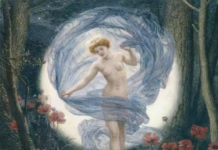
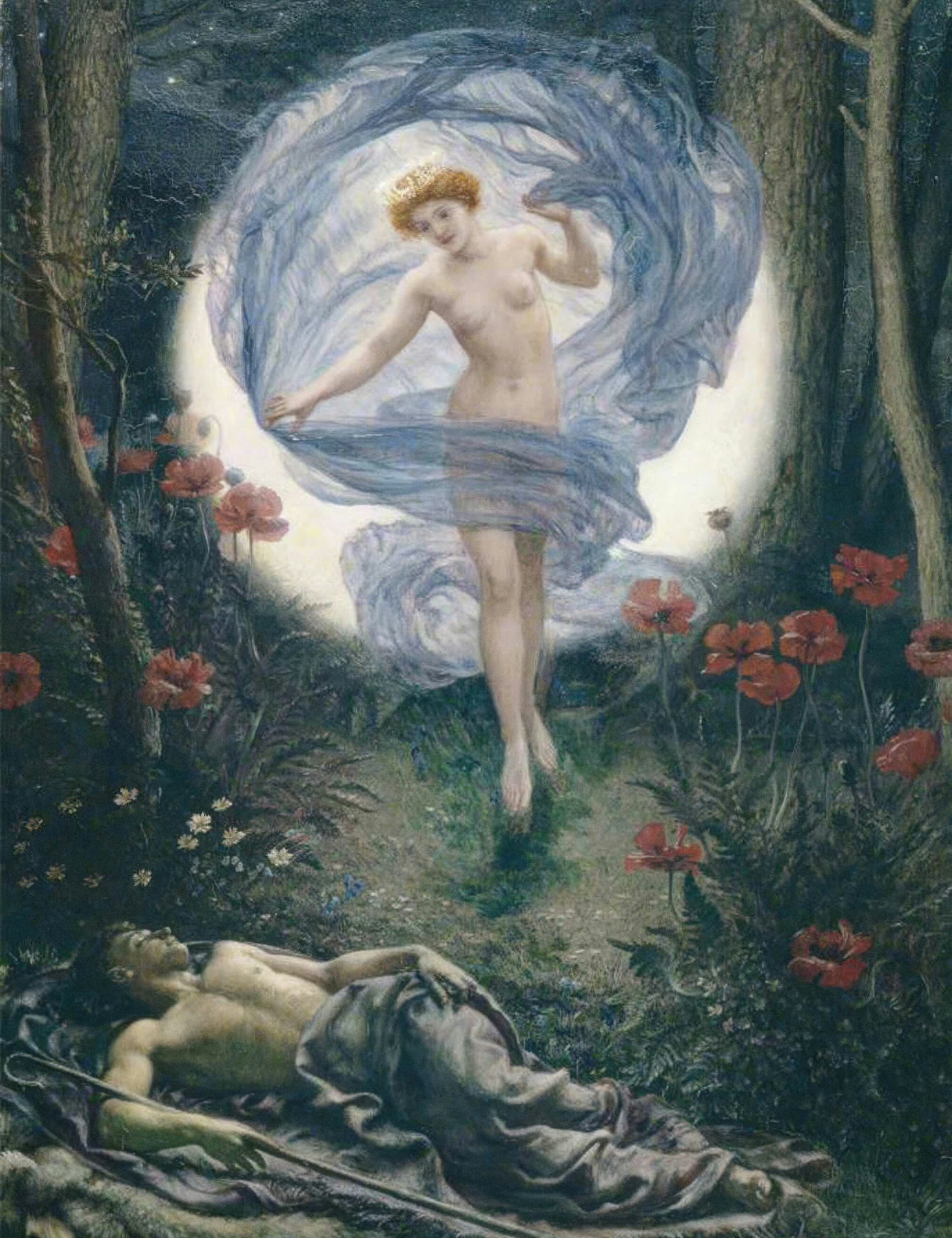
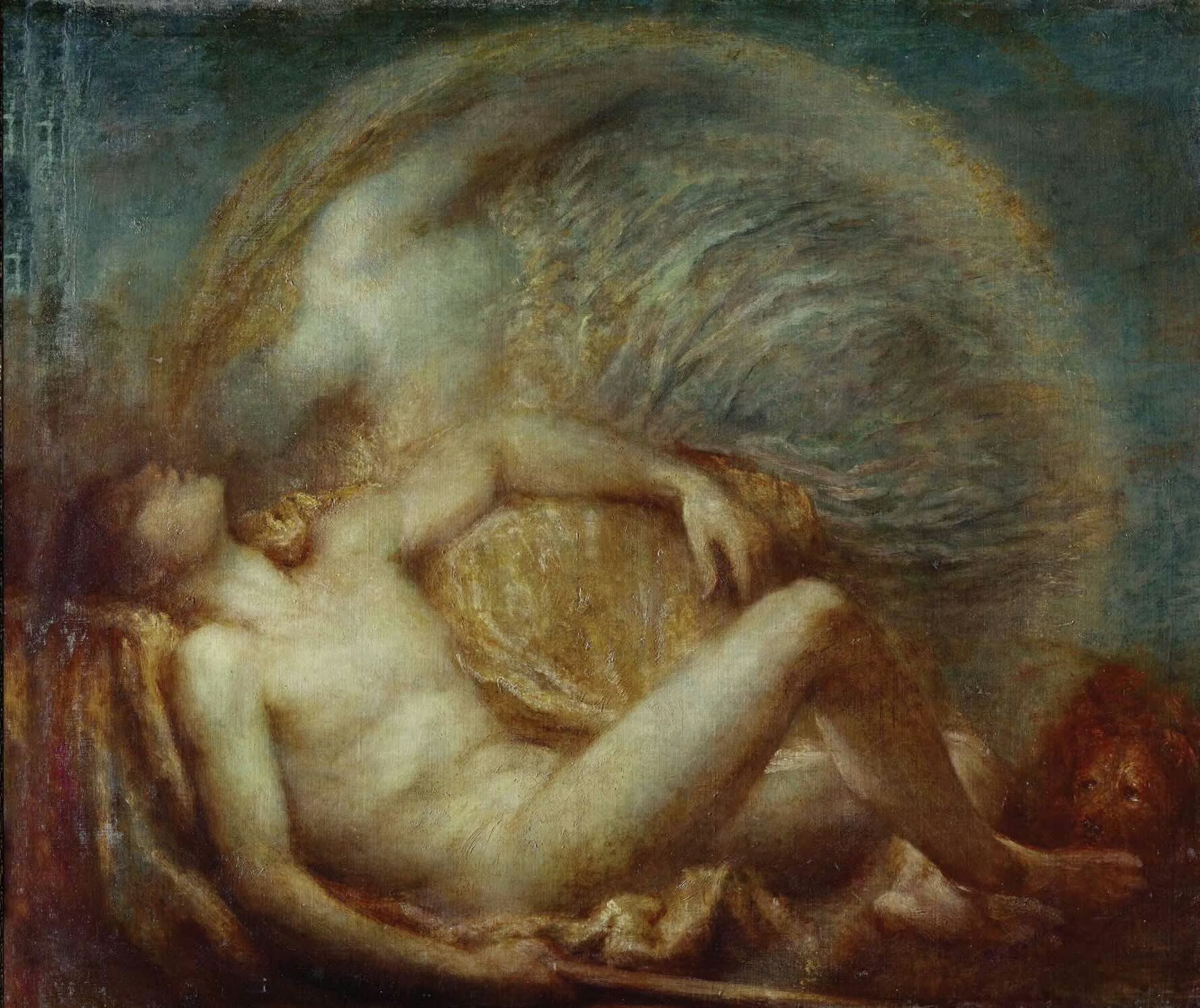
This rather lustier attraction becomes apparent in later depictions, such as Edward Poynter’s 1902 painting showing Selena skipping down from the sky to find her lover sleeping among the poppies, which denote his endless slumber. A year later, George Frederick Watts painted Selena as a swirling cloud engulfing her lover, creating a circle along with his golden sleeping form. The spirit of the goddess seems to enter the slumbering shepherd, who echoes her body above him, and they appear to form two halves of a whole. They become the phases of the moon together, symbolic of the time passing and the goddess’s love renewing eternally.
The tale of Endymion, the sleeping shepherd, adored in his unconsciousness, is remarkable for the passivity of the male protagonist. Our hero is eternally snoozing because a goddess wanted to possess him. His best qualities are being submissive, silent, and decorative—talents usually required of heroines and yet this feminization of a hero is accepted as a triumph and the pinnacle of romance. There is also a reflection of nature and its joyful cycles. You can interpret Selena’s swooping down to Endymion every night as the lowering of the moon so that the sun can rise, as his name may be derived from the Greek word for “to dive into.” Thus Endymion’s power is to tempt the moon down every night so that the sun can rise and day can come again. In that way, his beauty is his power, keeping the world turning even from his endless sleep. Likewise, Selena’s love is not destructive like that of some of her fellow immortals, but revives each night, new and passionate, to last forever.